Paid search has been the workhorse of digital performance marketing for twenty years. Google Ads built an industry. You bid on keywords, your ads appear when people search those terms, you pay per click, you optimize for conversion rate, you analyze ROAS. The machine is well-understood, the metrics are clear, and the feedback loops are fast.
LLM SEO is the opposite of all of that in interesting ways. It’s slower. The attribution is fuzzier. You don’t “bid” for placement in an AI-generated answer — you build it through content and credibility over time. It’s closer to earned media than paid media in its logic, even though it operates in what used to be “search.”
Whether one outperforms the other isn’t a universal question with a universal answer. It depends on what you’re trying to accomplish, in what category, over what timeframe. But the comparison is worth thinking through carefully because the right allocation between them is changing — and most marketing teams haven’t updated their frameworks to account for it.
What Paid Search Does Well (And Where It Falls Short)
Paid search excels at capturing demand that already exists and is ready to convert. Someone searching “buy running shoes” or “enterprise project management software demo” is deep in consideration mode. They know they want something. Paid ads can intercept that intent and convert it efficiently.
The strengths: fast, controllable, attributable, scalable. Turn the budget up, get more clicks. Turn it off, the traffic stops. The economic feedback loop is relatively tight.
The weaknesses are also real. Paid search requires ongoing spend — the moment you stop paying, you disappear. Costs per click in competitive B2B categories have risen dramatically over the past decade, and in some verticals, the economics have gotten genuinely challenging. You’re also only capturing people who are already searching; you’re not influencing anyone who doesn’t yet know they need what you offer.
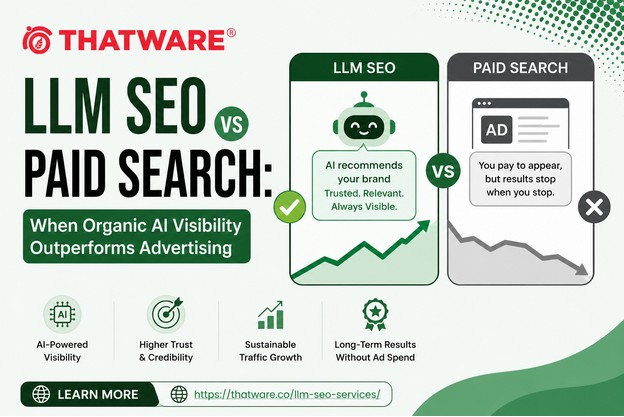
And crucially: paid search doesn’t work in AI-generated answers. You can’t buy your way into a ChatGPT or Perplexity recommendation. AI citation is entirely organic — a function of the information environment, not the advertising budget.
What LLM SEO Does Well (And Where It Falls Short)
LLM SEO excels at awareness-stage influence — shaping who gets considered before a buyer’s intent is crystallized enough for them to run a branded search. It works at the “what are my options?” stage of a buying journey, before the buyer has formed enough intent to search specifically for a product or category.
LLM SEO vs traditional SEO comparisons tend to focus on the mechanism differences, but the more meaningful comparison for budget allocation purposes is LLM SEO vs paid search. The former builds a durable, compounding asset; the latter creates a rent relationship with a platform.
The advantages: once built, AI visibility doesn’t require ongoing per-click expenditure. A brand that’s well-established in AI knowledge systems continues to be cited in relevant responses without continuous budget outlay. The presence is durable in a way that paid placement never is.
The weaknesses: slow to build, hard to attribute, impossible to control precisely. You can influence how AI models represent you, but you can’t dictate it. And the connection between an AI citation and a conversion is often indirect and difficult to measure.
When AI Visibility Outperforms Paid Search
There are specific conditions where investing in LLM SEO delivers better return than equivalent investment in paid search.
High-consideration, long-cycle purchases. In B2B enterprise sales where buyers spend months researching before engaging vendors, being present in the awareness and orientation phase is enormously valuable — and that phase is increasingly AI-mediated. Paid search captures late-stage intent; LLM SEO captures early-stage orientation. For products with six-to-eighteen-month sales cycles, the early influence often matters more.
Expensive paid search categories. When CPCs in your category are $20, $50, or $100+ per click, the math on paid search gets challenging quickly. LLM SEO has high upfront investment but doesn’t scale linearly with traffic volume — a well-established AI presence continues to generate awareness without per-click costs. At high CPC levels, the economics of LLM SEO look increasingly attractive.
Thought leadership and expertise categories. Consulting, advisory, professional services, and other categories where perceived expertise is the purchase driver — these are categories where AI citation in response to expertise queries has enormous commercial value. There’s no paid search equivalent for “who are the leading experts in supply chain transformation?” Organic AI visibility is the only way to win that query.
Challenger brands and new entrants. In categories where incumbents have monopolized paid search through massive budgets and Quality Score advantages, LLM SEO offers a path to visibility that doesn’t require outbidding well-funded competitors. The playing field is more level in AI citation than in paid search, at least for now.
When Paid Search Still Wins
Equally, there are conditions where paid search remains the right primary investment.
Transactional, high-intent queries. If someone is searching “buy [specific product],” paid search is probably the most efficient interception point. The intent is already crystallized. The conversion path is short. LLM SEO can influence earlier stages, but paid search captures the moment of action.
Short timeframe requirements. If you need pipeline in thirty days, LLM SEO can’t help you — it takes months to build. Paid search can be turned on and generate qualified traffic immediately. For campaign-based demand generation with short windows, paid remains necessary.
Highly measurable ROI requirements. If your organization requires clean, attributable performance metrics tied to marketing spend, paid search delivers that in ways LLM SEO currently cannot. The attribution challenges of AI-influenced discovery are real, and some organizations simply aren’t in a position to make the measurement ambiguity work.
The Portfolio Approach Most Brands Should Adopt
The most sophisticated answer is that LLM SEO and paid search serve different stages of the buyer journey and shouldn’t be treated as direct competitors for budget. The question is portfolio allocation.
LLM SEO services invested early and consistently build awareness-stage influence that reduces the cost of demand capture downstream. A buyer who encounters your brand positively in an AI answer before they ever run a commercial search is more likely to click your ad and convert when they do reach paid search. The two channels reinforce each other when both are working.
The optimal allocation varies by category, sales cycle length, competitive intensity in paid search, and maturity of LLM visibility investments. But most brands with long consideration cycles and high CPCs are under-invested in LLM SEO relative to what the economics justify.
The paid search playbook was written for a world where people discovered things primarily through active, intent-driven search. That world is transitioning rapidly. The brands that adapt their channel mix now, building the AI visibility that shapes early-stage awareness, will find the paid search they do run performing better — because the buyers arriving at their ads already have a warmer brand impression than cold intent-driven traffic ever provided.
